UI Designer vs. Frontend Developer: Who to Hire

A UI designer decides how a product looks and behaves; a frontend developer builds that design into working, production code. The designer owns layout, hierarchy, interaction, and the design system in a tool like Figma. The frontend developer owns the HTML, CSS, and JavaScript that turn those screens into a real, responsive, accessible interface people can actually use. Same surface, two different jobs.
I get asked to clarify this constantly, usually by founders who just wrote a job description that accidentally described two people. So here is the honest, practical version from someone who sits close to both sides.
What a UI designer owns
A UI designer is responsible for the decisions a user feels but rarely names: where the eye lands first, how far apart things sit, what a button looks like in every state, and whether the whole thing feels calm or chaotic. The deliverable is a set of screens, prototypes, and a design system — not a running website.
- Visual and interaction design — layout, typography, color, spacing, and the flows between screens.
- Information hierarchy — deciding what a user should see first, second, and never.
- Design systems and components — reusable buttons, inputs, and patterns so the product stays consistent as it grows.
- States and edge cases — empty, loading, error, and success, not just the happy path.
- Handoff — specs, tokens, and annotations a developer can build from without guessing.
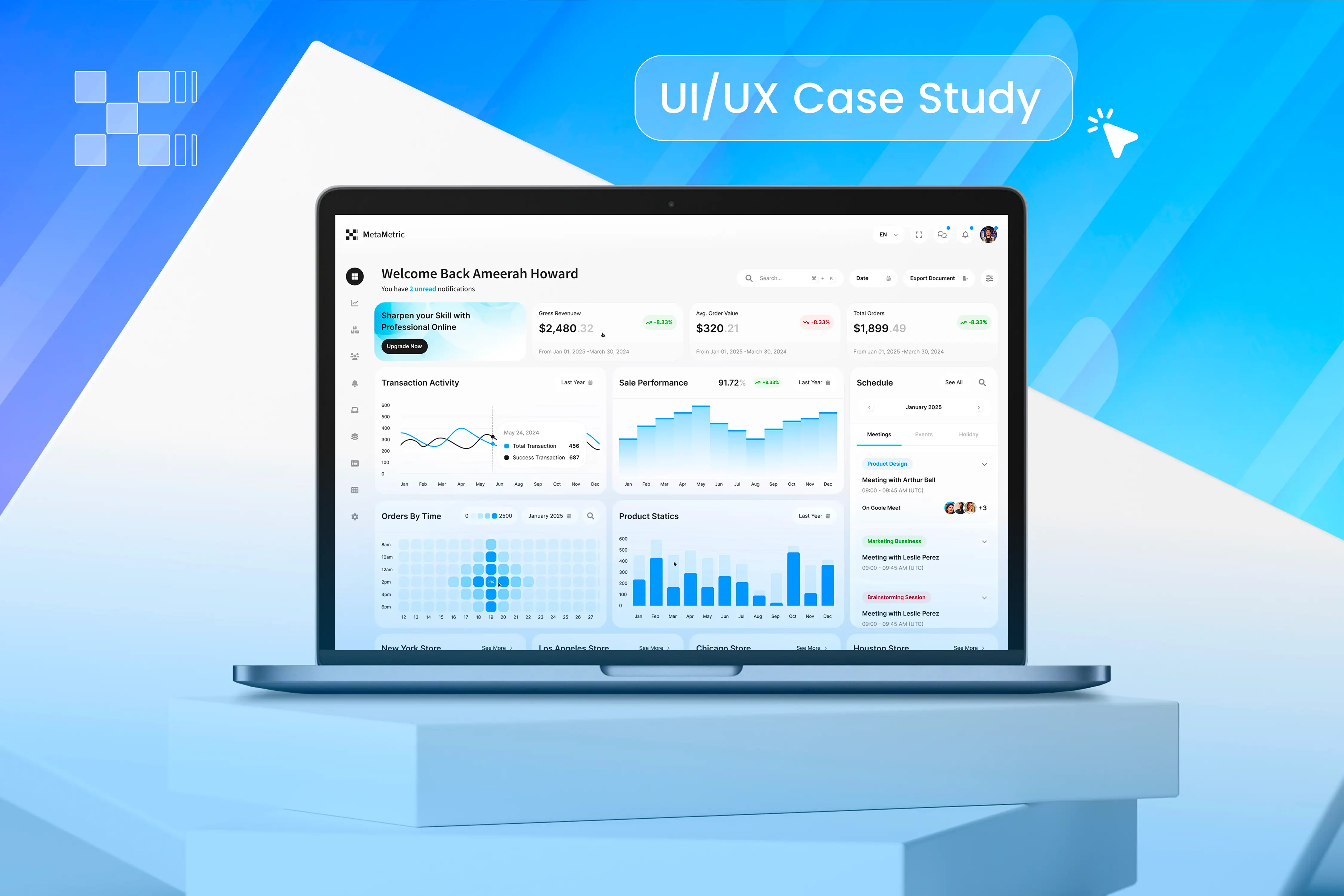
When I designed the MetaMetric analytics UI and data-heavy dashboards generally, most of the work was invisible: deciding what a busy user ignores so the important number survives. That is a designer's job, and it happens before a single line of production code exists.
What a frontend developer owns
A frontend developer takes the design and makes it real in the browser. Their deliverable is code that runs, performs, and holds up across devices and edge cases the mockup never showed.
- Implementation — turning screens into semantic HTML, CSS, and JavaScript (often React, Vue, or similar).
- Responsiveness — making one design work from a 320px phone to a wide monitor.
- State and data — wiring the interface to APIs so it shows real content, not placeholders.
- Performance and accessibility — load speed, keyboard support, screen-reader behavior, and browser quirks.
- Maintainability — code other engineers can extend without it collapsing.
A strong frontend developer will catch things a static mockup can't reveal — what happens when a title is 200 characters long, or the network is slow, or the list is empty. Those are engineering problems, and they matter as much as the visual polish.
Where the two roles overlap
The confusion is real because the overlap is real. Both roles care about the interface, and the best people in each are fluent in the other's language.
A good UI designer understands what is expensive to build and designs within reason. A good frontend developer understands spacing, rhythm, and why a design falls apart when you nudge the padding. The overlap zone is roughly: component structure, interaction states, responsive behavior, accessibility, and the design system that connects Figma to code.
But overlap is not sameness. A designer who can write a bit of CSS is not a substitute for an engineer who owns your production frontend, and an engineer with good taste is not a substitute for someone whose full job is the user experience. Treating them as interchangeable is how products end up either pretty and broken or functional and joyless.
- Hire a UI designer if your product works but feels confusing, inconsistent, or dated, and users don't understand it.
- Hire a frontend developer if you have solid designs but no one to build them well, or the current build is slow and buggy.
- Hire a design engineer if you're early-stage, need design and clean frontend in one loop, and can't yet justify two hires.
- Hire both if you have real product scope, a growing UI, and enough work to keep each fully busy.
Signs you need a UI designer, not a developer
You already have engineers, but the product looks like engineers designed it. Screens are inconsistent from page to page. New features get bolted on without a system, so everything drifts. Users hesitate, misclick, or churn on flows that should be obvious. These are design problems, and no amount of clean code fixes a confusing layout.
This is also where the business case lives. Better structure and clarity move real numbers — I wrote about that in the ROI of UX design. A developer builds what they're handed; a designer decides whether what's being handed over is worth building.
Signs you need a frontend developer, not a designer
The opposite case: your designs are strong, but they live in Figma and nowhere else. Or the site is live but slow, breaks on mobile, or ships with obvious bugs. If your bottleneck is "we have the design, we just can't build it well," you need engineering — and performance is a conversion issue too, which I cover in why performance-driven design converts better.
The hybrid option: a design engineer
There's a third path that fits a lot of startups: the design engineer — someone who designs the interface and can build a good chunk of the frontend, or at least hand off code-ready work that engineers trust.
That's the lane I work in. Guljar Hosen is a UI/UX and product designer in Sylhet, Bangladesh with a software-engineering background — I'm a Software Engineering student at Metropolitan University Sylhet, and I run the studio NeoDimensional. To be precise about it: design is the lead skill and I build the frontend myself — a design engineer. Backend architecture I scope with my studio team rather than doing it solo. But I will design your product and produce frontend-aware, developer-ready work — and I think in components, not just pictures, which is why I build Figma design systems developers actually use.
For an early team, that single loop is valuable. You skip the translation gap where a designer throws mockups over a wall and a developer reverse-engineers the intent. I've done this across products like Finestack, FeedFlow, BoostVPN, and OrthaCare — you can see the range in my case studies.
So which should you hire?
Be honest about your actual bottleneck. If users are confused, hire design. If good designs aren't getting built, hire frontend. If you're small and need both in one person to move fast, a design engineer bridges the gap until the volume justifies splitting the roles. Over 7+ years, 1,000+ landing pages and 150+ projects — including work with US startups and Amazon and Walmart storefront design earlier in my career — the pattern I keep seeing is that the wrong hire isn't usually the wrong person, it's the wrong role for the problem. And if you're weighing remote, I've written honestly about working remotely with US startups from Sylhet, Bangladesh.
If you're not sure which role your product needs right now, tell me what's breaking and I'll give you a straight answer — even if the honest answer is that you need a frontend developer and not me.

Product-minded UI/UX designer & Figma specialist. I design conversion-focused, frontend-ready digital experiences for SaaS teams, startups and brands.